Back to work

Case study 01 / 04

Reviba
demand tests

The short version

Four product ideas went in front of real customers as Meta ads before Alumo committed to building any of them. The heat pump won with 362 leads, five times the baseline. The weakest offer went back to the drawing board.

Role
Product designer: briefs, ad design, copy and compliance flags
Team
Alumo leadership team
Timeline
One quarter
Method
Meta A/B tests, one change per variant

4

product ideas tested with real ads

362

heat pump leads

5×

baseline lead volume

1

offer sent back for a rework

01

The brief

A shortlist of good ideas, and no way to know which one people wanted.

My rock for the quarter was a product development plan to grow revenue through three paths: win market share, launch new products or services, or expand into new markets. The shortlist was ranked on revenue, cost, profit and ease.

Every idea looked good on paper. Building any of them meant stock, installs, training and new processes. That is an expensive way to find out nobody wants something, so we tested demand first.

The rule we kept coming back to

“Don’t optimise processes that shouldn’t exist.”

02

The approach

Treat every idea as a hypothesis, and every ad as the test.

I call this lead-generating design. Each product became a Meta campaign under a test brand, Reviba, with variants running at the same time. Each variant changed one thing, so a winner could be traced back to a single cause.

The goal was never one good campaign. It was a repeatable formula for finding lead-generating winners, so the next idea could be tested faster than the last.

  1. 01

    Brief

    A creative brief per product: the offer, who it is for and the job it does for them.

  2. 02

    Design

    Carousel ads, copy written to Alumo’s writing rules and prompts for the imagery.

  3. 03

    Check

    Compliance flags raised with the CEO before anything went live.

  4. 04

    Run and read

    Variants live in parallel, read on lead volume and cost per lead.

03

The four tests

Four offers. One question: would people raise their hand?

Heat pump leads3625× the baseline lead volume

Integrated heat pump

Winner
The offer
A monthly plan from R600 for a 200L system, built around one message: cut the single biggest line item on your bill.
Why it might work
Geysers are 30 to 60% of a typical home’s electricity spend, and a heat pump delivers 3 to 5 units of heat for every unit of electricity.
What happened
362 leads, five times the baseline. The creatives that led with savings performed best.
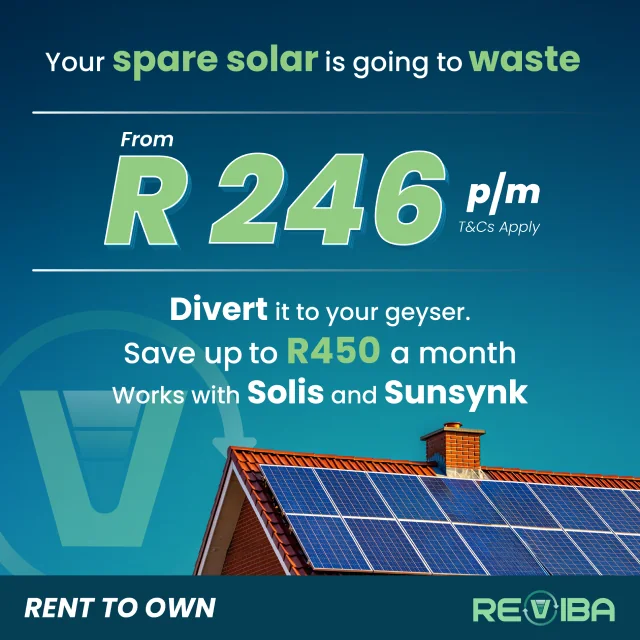
The PV diverter test ad

PV diverter

Test with care
The offer
Save up to R450 a month by sending surplus solar to the geyser instead of wasting it.
Why it might work
The job: get more value from solar already on the roof, in a country where most homes can’t sell power back to the grid.
What happened
Moderate. Cheaper leads than typical solar campaigns, but a small ticket and a narrow segment.
The Off-grid packages test ad

Off-grid packages

Controlled rollout
The offer
Three configurations of 3, 12 and 19 panels, each with a battery and generator backup.
Why it might work
Smaller solar systems with a generator behind them were starting to gain traction.
What happened
Decent, with a very narrow customer profile.
The Reviba Care test ad

Reviba Care

Rework
The offer
A protection plan in three variants: insurance, annual service, panel wash, monitoring and call-outs.
Why it might work
The job: take the stress out of owning a system once the installers have left.
What happened
35 leads across all three variants. The weakest result of the four.

04

What the data said

Leads were only half the answer.

A lead tells you someone is interested. It doesn’t tell you whether the product makes money once it is installed, or what it costs the team to support. So every result was read twice: once for demand, once for what it would do to gross profit and to operations.

Insight 01

Savings sell.

The heat pump creatives that led with savings outperformed every other angle.

Insight 02

Nobody pays twice.

Insurance was the worst performer. Part of the audience came from Alumo’s customer lists, and they already get insurance with Alumo.

Insight 03

Peace of mind beats cover.

Call-outs resonated more than insurance or panel washing. People wanted to know that if something goes wrong, it’s handled.

Insight 04

Revenue isn’t profit.

Off-grid packages would add revenue, but generator maintenance adds field work and very little gross profit.

My call on the PV diverter

“I don’t want to add another thing that drives call-backs and costs us R1,000 to fix if it’s not delivering profit.”

Someone asked why we didn’t just install it for everybody if it was that cheap. We agreed to keep testing it, with site assessors asking prospects whether their systems were throttling before offering it.

05

The decisions

From a list of ideas to a plan with gates.

Every test fed a roadmap with three lanes. Strong demand alone didn’t earn a launch. It earned a deeper look at price, gross profit and what it would ask of the install teams.

This quarter

  • Heat pump deep diveConfirm the purchase price and install scope, model a 35% gross profit and check install capacity before a go or no-go.
  • PV diverterKeep testing, qualified by site assessors. Move it to next quarter if it taxes operations without hitting a profit threshold.
  • Subscription rolloutLaunch now and optimise next quarter. This became case study 02.
  • 13.8kW inverterConfirmed by the supplier, with a two-month lead time.

Next quarter

  • Referral programmeScale an easier referral programme. I had already started the wireframes. This became case study 03.
  • Off-grid packagesA controlled scope, watching gross profit and operational complexity.
  • Compact indoor systemsAfter vendor meetings and test units.

Rework first

  • Reviba CareReframe around call-outs, not insurance. First, cost the call-outs and warranty work Alumo already absorbs.
  • Retail for lower-LSM homesHigh interest but untested. Find a safer path that is NRS-compliant.
  • EV installer partnershipLow margin. Deprioritised until charger partners are ready.

06

The gates

Before the heat pump could launch, it had to answer four questions.

  1. Gate 01

    Can we hit 35% gross profit?

  2. Gate 02

    Can one team do three installs a day?

  3. Gate 03

    Do we hire a plumber, or train someone in plumbing and electrical?

  4. Gate 04

    Does it tax our processes without meeting a profit threshold?

07

The next iteration

Measure what happens after the click.

Lead volume got us here. The next round tracks whether a lead becomes an install that makes money, and what each product costs to support once it is on the roof.

Reviba Care doesn’t relaunch until the real cost of call-outs and warranty work is known. Then the offer gets rebuilt around the thing people responded to: knowing it’s handled.

Contact

Let’s work
together.

Open to product design and UX roles, remote or in-house. The quickest way to reach me is email.

timothyenricomoses@gmail.com
LinkedIn Download CV